Ford Rear Axle Identification Codes? Better 7 Decode Idea
Ford rear axle codes are key to know what your vehicle’s rear axle needs. These codes reveal the axle’s type, model, and if it fits your vehicle, which is vital for the right repairs and upgrades.
By understanding these ford axle codes, you pick the correct parts. This ensures your vehicle performs better and stays safe.
In this article, we’ll show you how to decode ford rear axle identification codes. This makes understanding your Ford’s axle setup simpler.
You’ll learn where to find your axle ID and how this info helps in deciding on repairs or upgrades.
Knowing these codes is the first step for proper maintenance and enjoying your Ford for years. Let’s explore Ford rear axle codes together and give you the knowledge you need!
What is The Importance of Ford Rear Axle Codes?
For any Ford vehicle owner, getting to know ford rear axle codes is crucial. These codes serve as clues, telling you about your axle type.
They play a big part in your vehicle’s performance and part compatibility, affecting maintenance. Identifying your Ford’s rear axle is key for upgrades or repairs.
Each axle code links to different gear ratios and capacities. This knowledge lets you grasp how your vehicle performs, its towing power, and if it needs tweaks for better reliability and performance.
Decoding ford rear axle codes helps you make smart maintenance choices. Whether fixing problems or planning upgrades, these codes give you the info needed. This ensures your Ford performs its best.
Decoding Ford Rear Axle Identification Codes
To figure out Ford axle codes, you need to know their format. It’s made up of letters and numbers. Each part of the code tells us something important.
Like when it was made, how much weight it can handle, and the gear ratios. These numbers on a Ford axle can be split into parts. Each part tells us something different.
At the start, you might see the model year and where it was made. After that, there are numbers for how it’s made and the gears it uses.
The Bill of Materials (BOM) number is super helpful. It takes you to a list of everything used in your axle.
Learning this can help you a lot. It makes fixing or upgrading easier because you’ll know exactly what you need.

Where To Find Your Ford Rear Axle Identification
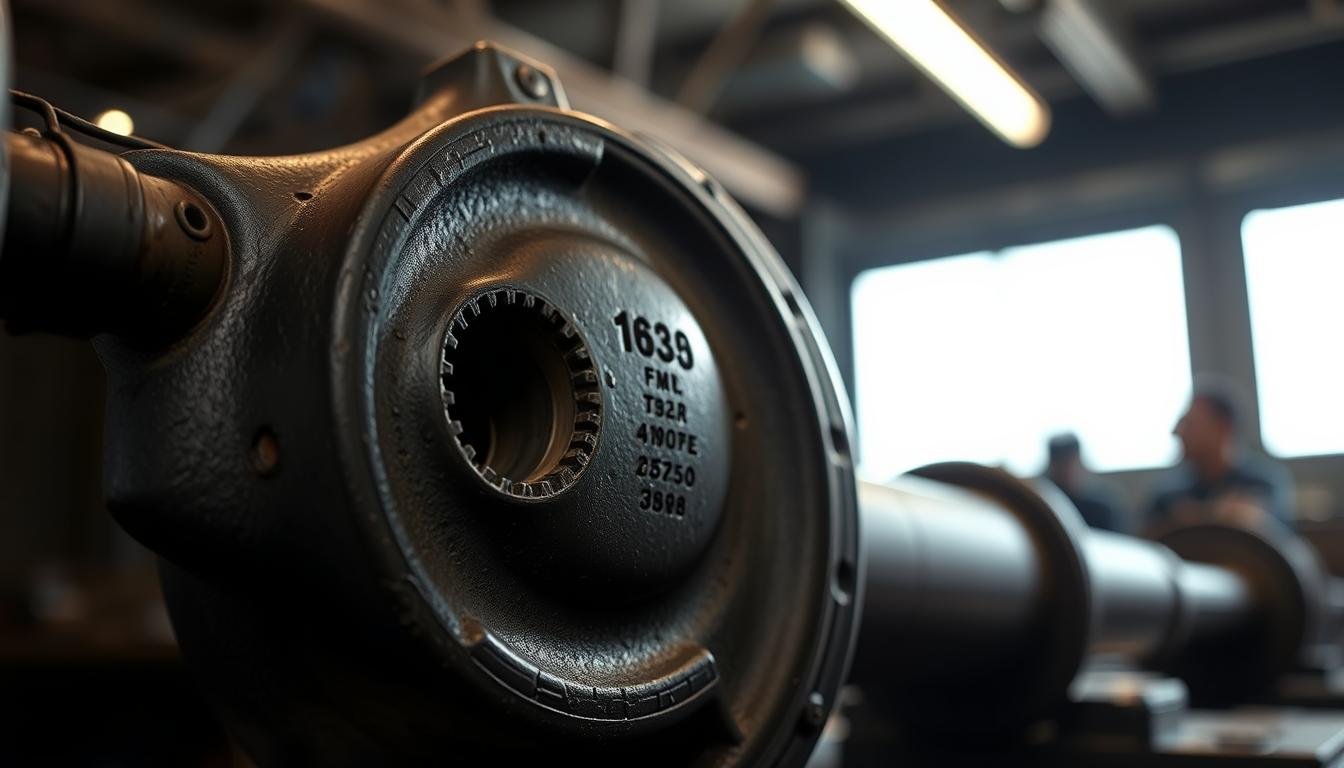
Finding the Ford rear axle identification is key for vehicle service or part upgrades. You can find the ID tag on the axle housing or a stamped number on the axle tube.
Here are some steps to discover this crucial info.
- Start by checking the ford axle tag location on the driver’s side of the differential. This is commonly where manufacturers place the identification tags.
- For many Ford models, look on the axle housing itself. You may need to clean the area around the housing to see faint markings.
- On some vehicles, the identification may be stamped into the axle tube. Look for a series of numbers and letters; these will be essential for identification.
- Use a flashlight to illuminate hard-to-see areas. Sometimes, dirt and grease can obscure the tag or stamp.
Model-specific guidance is in your vehicle’s service manual for different Ford models.
Knowing where to look makes finding the Ford rear axle ID easier. This ensures you have the needed info for repairs or changes.

Ford Rear Axle Identification Codes: A Comprehensive Guide
Knowing the ford rear axle identification codes guide is key for any Ford owner. Every code tells you about your axle, like model numbers, gear ratios, and types.
We’ll explain common codes and what they mean. Different Ford models and years have various axle code meanings.
It’s important to know your vehicle’s specifics. This knowledge aids in pinpointing your axle and ensuring the right repairs or replacements.

Here’s a table showing some common Ford rear axle identification codes and their meanings:
| Code | Description | Gear Ratio | Affected Models |
|---|---|---|---|
| 3.31 | Standard Performance Axle | 3.31:1 | Mustang, F-150 (2011-2020) |
| 3.55 | High Performance Axle | 3.55:1 | Mustang GT, Explorer (2015-2020) |
| 4.10 | Off-Road Performance Axle | 4.10:1 | F-250, F-350 (2017-2020) |
| 2.73 | Economy Axle | 2.73:1 | Ranger, Edge (2000-2007) |
Check the ford rear axle identification codes guide to decode your vehicle’s axle details.
Knowing axle codes meanings helps in making repairs or changes. This improves your vehicle’s performance and reliability.
Common Ford Rear Axle Codes and Their Meanings
Getting to know ford axle codes is vital. It helps you identify your vehicle’s rear axle correctly. These codes share details about the axle type and different gear ratios.
They are key for tuning performance and upkeep. Here’s a quick guide to common codes and what they mean, making ford rear end identification easier.
| Axle Code | Model Year | Axle Type | Gear Ratio |
|---|---|---|---|
| 92 | 2002 – 2005 | 8.8” Semi-Floating | 3.55 |
| 4.10 | 1994 – 2001 | 8.8” Semi-Floating | 4.10 |
| D1 | 1971 – 1973 | 9” Floater | 3.25 |
| W | 1997 – 2004 | 7.5” | 3.08 |
This insight shows the variety and intricacy in ford axle codes. These codes can match several models, showing why exact identification is crucial.
Knowing your axle code helps in making wise repair choices. It also ensures your vehicle runs at its best.
How To Identify Your Ford Rear Axle by Tag
Finding out about your Ford rear axle by its tag is key to knowing what it can do. You can figure out how to check this by finding the axle tag.
It’s usually on one of the axle housing’s bolt heads. Once you find the tag, take your time to understand what it says.
You should look for:
- Manufacture Date: This tells you when the axle was made, so you can find the right parts.
- Gear Ratio: This number helps you know how the axle affects speed and power, important for hauling.
- Axle Model Number: It’s crucial for pinpointing the exact axle you have, helpful for repairs.
The tag tells you a lot about your axle. It’s smart to write down this info for later, like when you’re fixing or beefing up your axle.

Knowing how to read this tag can really boost how your vehicle runs and keeps you safe. It makes you more involved in figuring out your ford axle.
| Tag Element | Description |
|---|---|
| Manufacture Date | When the axle was made; crucial for compatibility with parts. |
| Gear Ratio | Indicates axle performance; important for acceleration and towing. |
| Axle Model Number | Identifies the axle type; necessary for accurate fixes and upgrades. |
Being good at finding out what your Ford rear axle tag means is great for making your vehicle better and taking care of it.
Using The Ford Rear Axle Identification Chart
The Ford rear axle identification chart is key for anyone fixing Ford vehicles. It lists axle codes and their specs, helping you quickly know your rear axle.
Start by finding your axle code on the axle tag. Then, use the chart to find matching parts or check what maintenance is needed. This makes fixing and replacing parts more effective.
| Axle Code | Type | Gear Ratio | Year Range |
|---|---|---|---|
| 9″, 31 Spline | Ford 9″ Rear | 3.00 – 4.56 | 1957 – Present |
| 8.8 | Ford 8.8″ Rear | 2.73 – 5.13 | 1986 – Present |
| 7.5 | Ford 7.5″ Rear | 2.73 – 4.10 | 1980 – Present |
Tools To Assist with Ford Axle Identification
Getting to know your Ford axle is easier with the right help. You can use online databases to find info on different axle models.
Websites for Ford fans are also full of tips and advice for specific models. Looking at printed guides is another great way to identify your Ford axle.
These books have clear diagrams, specs, and codes. For quick checks, mobile apps designed for car parts can give you axle info anywhere.
Professional mechanics can offer expert advice too. Talking to a mechanic who knows Ford cars well is a big help.
Also, joining online forums or local car clubs can boost your knowledge. Other car lovers like to share their tips about axles.
Using these resources will help you understand your car better. With the right tech and advice from others, finding axle info becomes a breeze. It makes caring for your car simpler and more effective.
Comparative Analysis of Ford Rear End Identification Codes
Ford’s rear end codes show a lot of differences over the years. Each code is important because it tells you about the axle’s specs.
You will find that the same code might mean different things for different models at different times.
This change over time is important when you are comparing Ford axles. Knowing these differences helps you choose the right parts for your car.
Ford’s codes have changed as car making got better and what buyers wanted changed. This could change how your car drives or what it needs to be fixed.
Below is a detailed chart showing how some Ford rear end codes changed over time:
| Model Year | Axle Code | Specifications | Notes |
|---|---|---|---|
| 1990 | G8 | 3.55:1 Gear Ratio | Prior to the widespread adoption of electronic controls. |
| 2000 | H4 | 3.73:1 Gear Ratio | Increased performance focus in design. |
| 2010 | R3 | 4.10:1 Gear Ratio | High torque applications introduced. |
| 2020 | S7 | 3.31:1 Gear Ratio | Efficiency emphasis with modern engineering. |
Using this chart can help you understand Ford rear end codes better. A good comparison helps you see how changes in design affect today’s cars.
What is The Role of Gear Ratios in Axle Codes?
Gear ratios play a big part in your Ford’s performance and gas mileage. Knowing about axle ratios is key for smart choices regarding your car’s hauling power and fuel use.
Each gear ratio changes how quickly your vehicle can speed up and cruise, linking closely to Ford axle codes.
Different gear ratios match up with certain axle codes. These can change how your vehicle handles different tasks.
For example, a low gear ratio boosts torque, making it better for pulling heavy loads. A high ratio, on the other hand, helps save gas on the freeway.
Keeping these points in mind is important when picking or changing your Ford axle. Looking into gear ratios means seeing numbers like 3.55, 3.73, or 4.10.
These numbers tell you about the driveshaft to wheel turn ratio. For instance, a 3.55:1 ratio means the driveshaft spins 3.55 times for each wheel turn.
Knowing this helps figure out your vehicle’s performance for your driving needs. If you’re thinking of upgrading your Ford axles, knowing axle ratios is very helpful.
A different ratio can really change how your car accelerates, how much gas it uses, and how much it can tow.
This choice should be based on how you drive and what you use your vehicle for.
Conclusion
Understanding Ford rear axle codes is key for any car owner who wants to maintain or upgrade their vehicle. You’ve learned how to find and read these identification codes.
This knowledge helps ensure your car runs well by correctly identifying your axle. The importance of knowing your Ford’s axle codes can’t be overstated.
It helps in maintenance and choosing the right parts for upgrades. With this info, you’re ready to handle axle issues better.
FAQs
Q: What are Ford rear axle identification codes?
A: Ford rear axle identification codes are special codes. They show axle types, gear ratios, and when they were made. This info helps fix or upgrade your axle correctly.
Q: How do I decode Ford rear axle codes?
A: To decode Ford rear axle codes, look at the codes on your axle. Each part of these codes tells you about your axle’s details, like its production and specs.
Q: Where can I find the identification tag on my Ford rear axle?
A: You can find the identification tag on the axle itself or stamped on it. Make sure to check well, even for hard-to-see marks, to find what you need.
Q: Why is it important to know the gear ratio of my Ford rear axle?
A: Knowing the gear ratio is key. It impacts how your vehicle drives, its gas use, and how much it can tow. It’s crucial for deciding on maintenance or upgrades.
Q: What tools or resources can help me identify my Ford rear axle?
A: Online databases, Ford’s manuals, and apps are great for identifying axles. Talking to experts or using forums can also offer more help.
Q: How do Ford axle codes vary across different models and years?
A: Codes change a lot between models and years. The same code might mean different things, depending on your vehicle’s make year. Always check your axle’s specifics.
Q: Is there a guide for interpreting Ford rear axle identification codes?
A: Yes, there’s a detailed guide. It explains axle codes well, helping you understand your vehicle’s rear axle better.